Renault Duster 1.3L turbo MT vs DCT: Performance compared
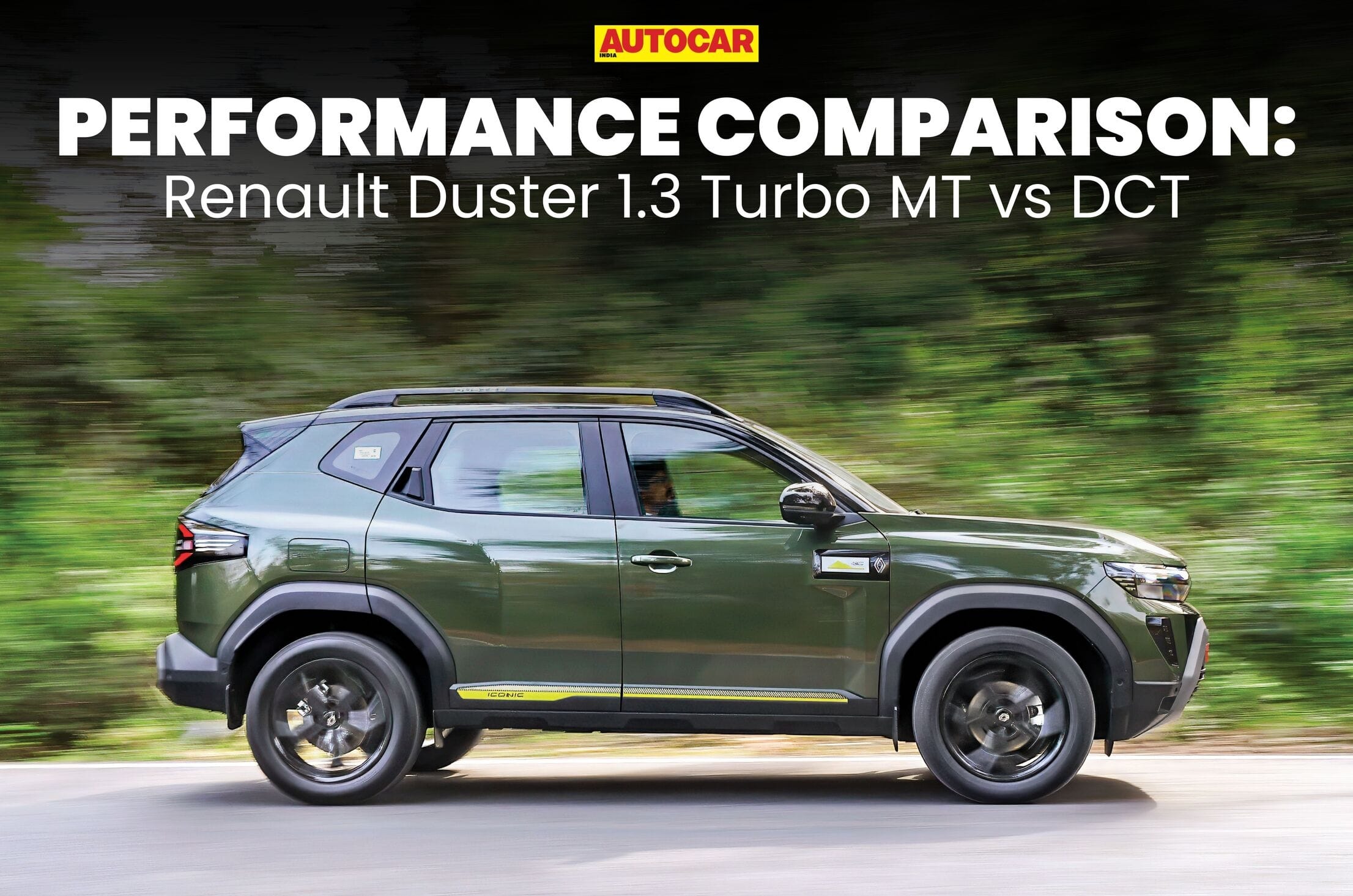
The Renault Duster was one of the first midsize SUVs in India, which was relaunched in 2026 after being absent from the Indian automotive space since 2022. With the new-generation model, Renault has equipped the Duster with not only a fresh design and more modern-day amenities, but also two turbo-petrol engine options. Among these, the larger 1.3-litre turbo-petrol mill is offered with both manual and DCT choices. But which one offers better real-world performance? Let us find out.
Renault Duster 1.3L turbo MT vs DCT: Specifications and price
The MT’s lower weight helps it with higher power- and torque-to-weight ratios
*Power-to-weight figures are hp per tonne
^Torque-to-weight figures are Nm per tonne
The Renault Duster’s 1.3-litre turbo-petrol engine offers the same output (163hp, 280Nm) with the 6-speed manual and the 6-speed dual-clutch transmission (DCT) options. However, as the manual version is 21kg lighter, it has slightly better power-to-weight and torque-to-weight ratios than the DCT version.
The manual transmission variants have lower price tags than the DCT variants. The Duster manual starts at Rs 12.99 lakh, which is Rs 1.5 lakh cheaper than the entry-spec DCT, and goes up to Rs 17.19 lakh, which is Rs 1.30 lakh less than the top-spec DCT.
Renault Duster 1.3L turbo MT vs DCT: 0-100kph acceleration test
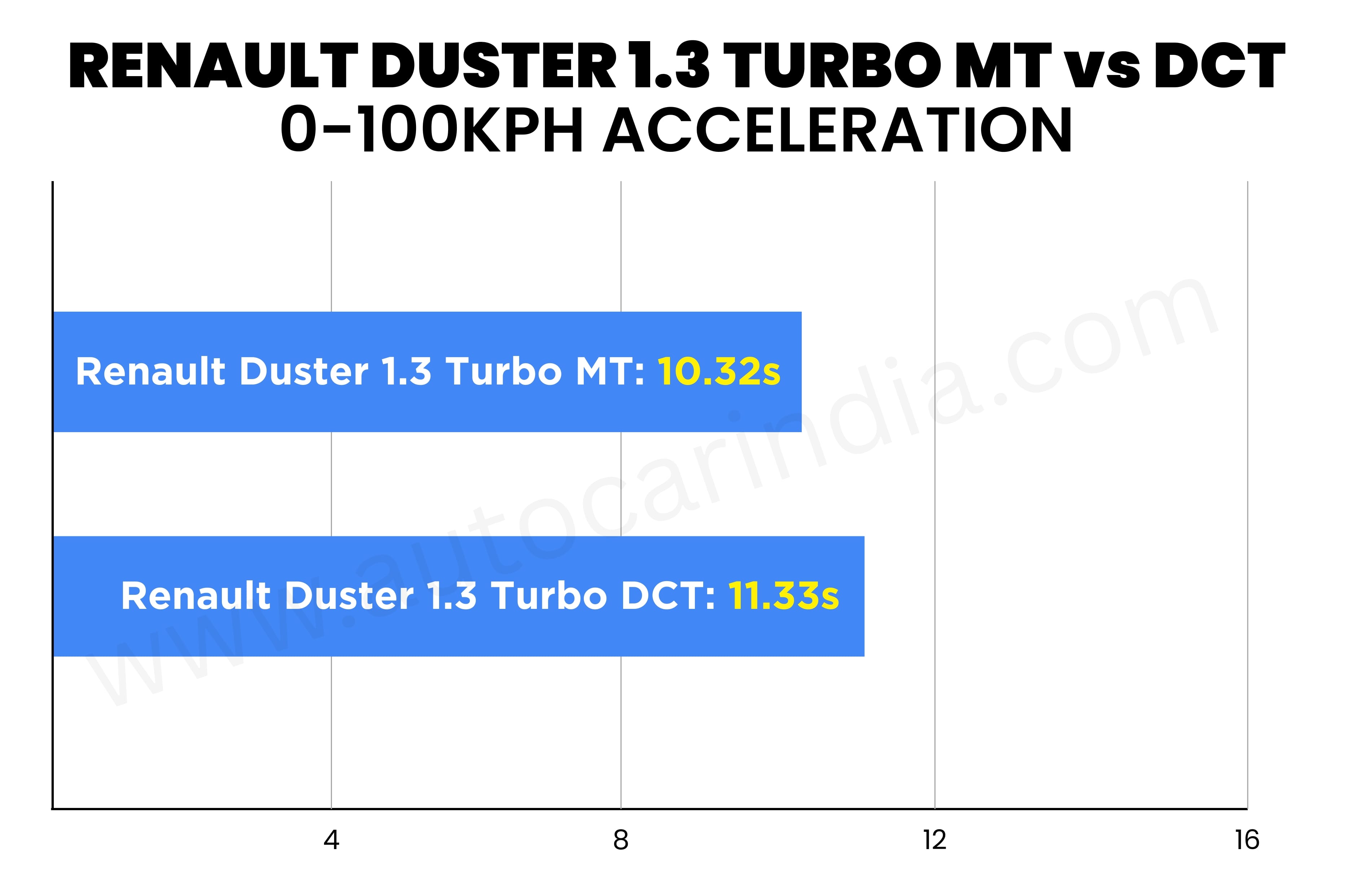
The manual option offers quicker acceleration off the line compared to the DCT
In our 0-100kph tests, we found that the Duster’s turbo-petrol manual version was faster than the DCT at all speeds. The manual version starts strongly, clocking 20kph 0.56 seconds faster, taking the difference to over a second by the time it reaches 40kph. The DCT catches up slightly at 60kph, reducing the difference to 0.91 seconds. However, the MT starts pulling faster again, and by the time it reaches 100kph, it has a 1.01-second lead.
In our experience, the manual feels engaging and rewarding when the engine is in the rev band. The clutch is light, and the shift action is precise too, which increases the powertrain’s likeability among enthusiasts. However, at slow speeds, turbo lag is evident, which, coupled with the tall gearing ratios, leads to a cumbersome city driving experience. It requires an extra downshift for a smoother drive experience.
The DCT’s wet clutch makes it the better option for city driving, as it prioritises smoothness over outright acceleration, feeling similar to a torque converter gearbox. While tall gearing is an issue at low-speed driving here too, the paddle shifters add an extra layer of engagement.
Renault Duster 1.3L turbo MT vs DCT: Rolling acceleration tests
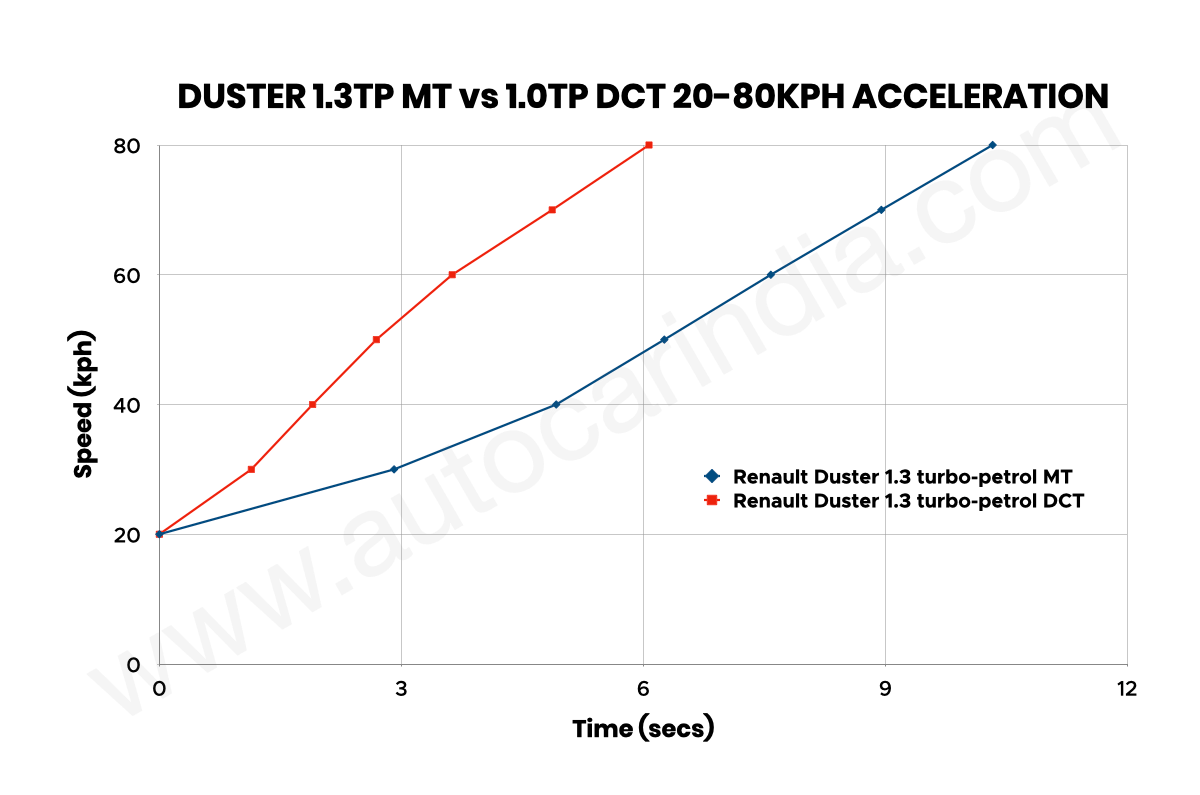
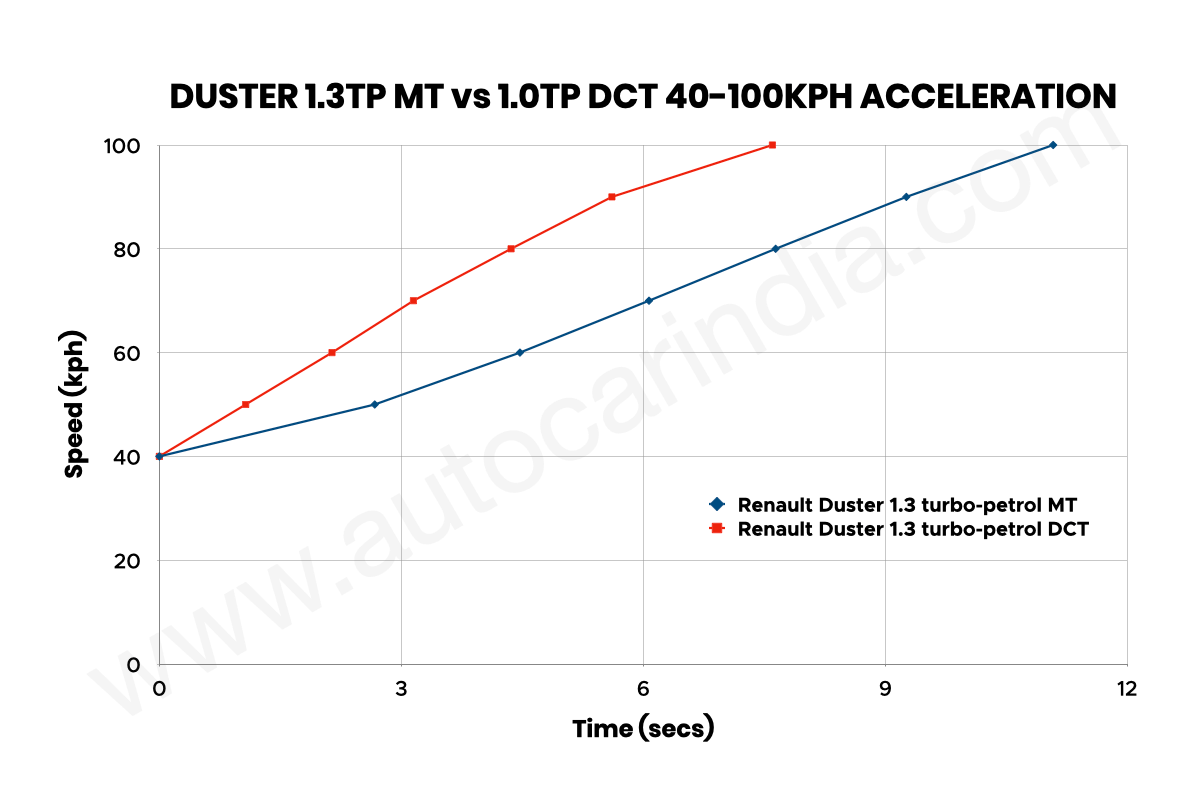
The DCT version clocked considerably quicker in-gear acceleration times
Unlike the outright 0-100kph acceleration times, the DCT version posted quicker in-gear acceleration times. In the third gear, it had a 4.26-second lead in the 20-80kph time, and in fourth gear, it was quicker by 3.48 seconds to record a 40-100kph run.
Autocar India’s testing standards
Before we conduct our performance tests, we check and maintain tyre pressures based on the manufacturer’s recommendation and ensure the car has a full tank of fuel. The car is then tested in a controlled environment with two people on board, and the data is collected via highly accurate GPS-based timing equipment.
Prices are ex-showroom, India.
from Autocar India https://ift.tt/nhsqI9m


Comments
Post a Comment