Kia Syros 1.0 turbo MT vs DCT: Real world performance compared
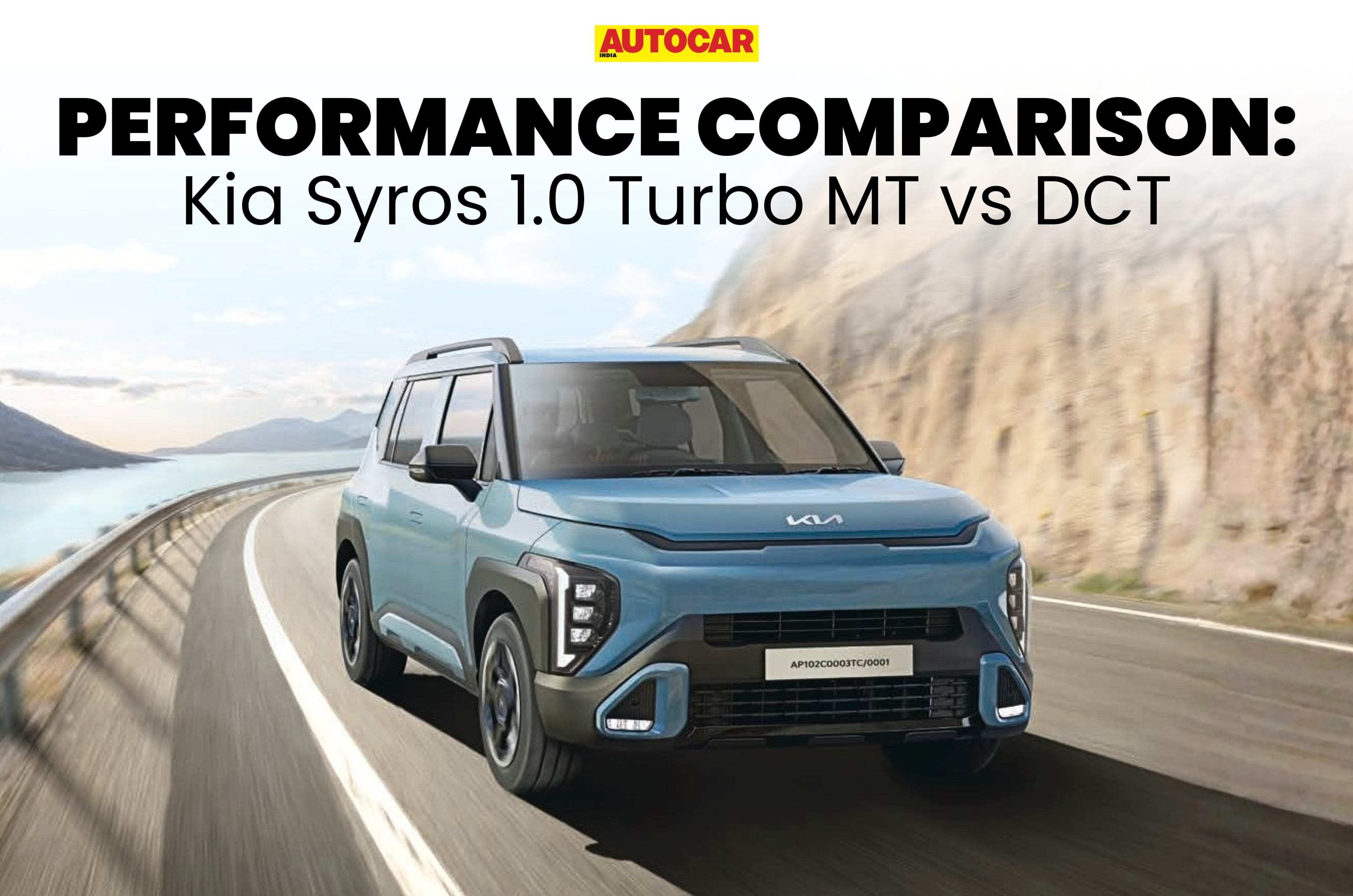
The Kia Syros is the Korean carmaker’s more premium compact SUV for the Indian market, positioned between the Sonet and the Seltos in the manufacturer’s lineup. It is available with a choice of turbo-petrol and diesel engines, with the 1.0-litre turbo-petrol being the most affordable turbocharged petrol offering from Kia in India. Buyers opting for this engine can choose between a 6-speed manual transmission and a 7-speed dual-clutch automatic (DCT). But which of these two powertrain options delivers better performance? Let’s find out.
Kia Syros 1.0L turbo-petrol MT vs DCT: Specifications and price
The Syros turbo MT’s top-end price is similar to the DCT’s starting price
Both the manual and DCT versions of the Kia Syros’ 1.0-litre turbo-petrol engine have identical outputs of 120hp and 172Nm. A fuel tank capacity of 45 litres is also identical. The price, however, is the distinction, the top-spec manual HTK+ (O) variant costing just Rs 6,000 more than the entry-spec DCT HTK+ variant.
Kia Syros 1.0L turbo-petrol MT vs DCT: 0-100kph acceleration test
The DCT version starts slower, but clocks a quicker 0-100kph time
In our 0-100kph tests, the Syros turbo MT has better acceleration from the get-go. As the speeds increase, the DCT version catches up. In fact, the Syros turbo-DCT reaches 100kph 0.32 seconds faster than the Syros’ turbo-petrol manual. However, the difference is lessened to 0.18 seconds when both Syros versions reach 120kph.
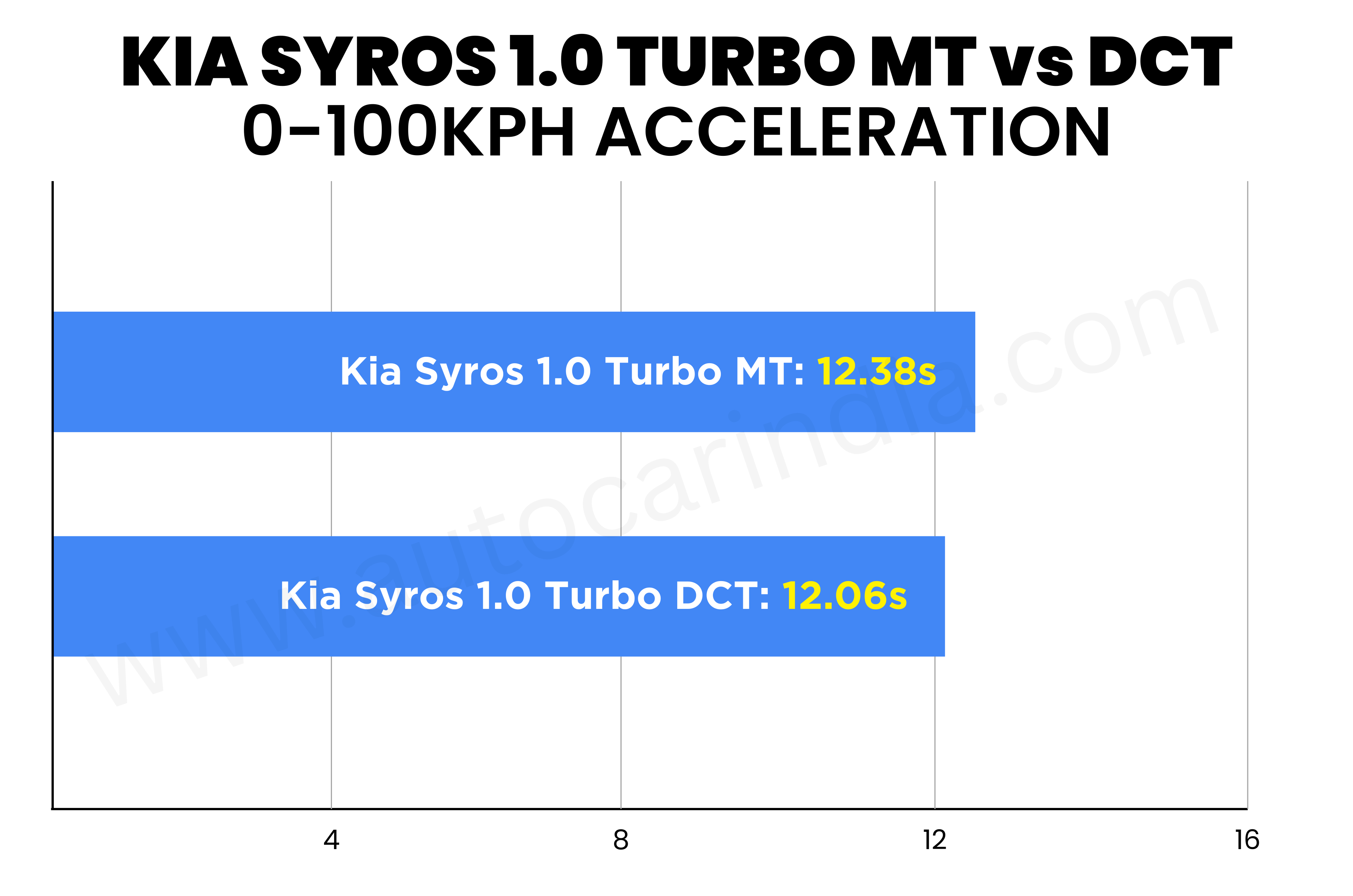
In our real-world tests, we found that the Kia Syros' 7-speed DCT offers smoothness over outright performance and is hence slow in comparison to the manual from the get-go. The manual, on the other hand, offers quicker outright acceleration as it allows the clutch to be 'slipped'.
However, the DCT version has shorter gear ratios that help it stay longer in the optimum rev band. It also readily drops multiple gears with a more-than-normal throttle input, keeping the engine in its power band when quicker acceleration is needed, allowing it to accelerate quicker as speeds build up.
Kia Syros 1.0L turbo-petrol MT vs DCT: Rolling acceleration tests
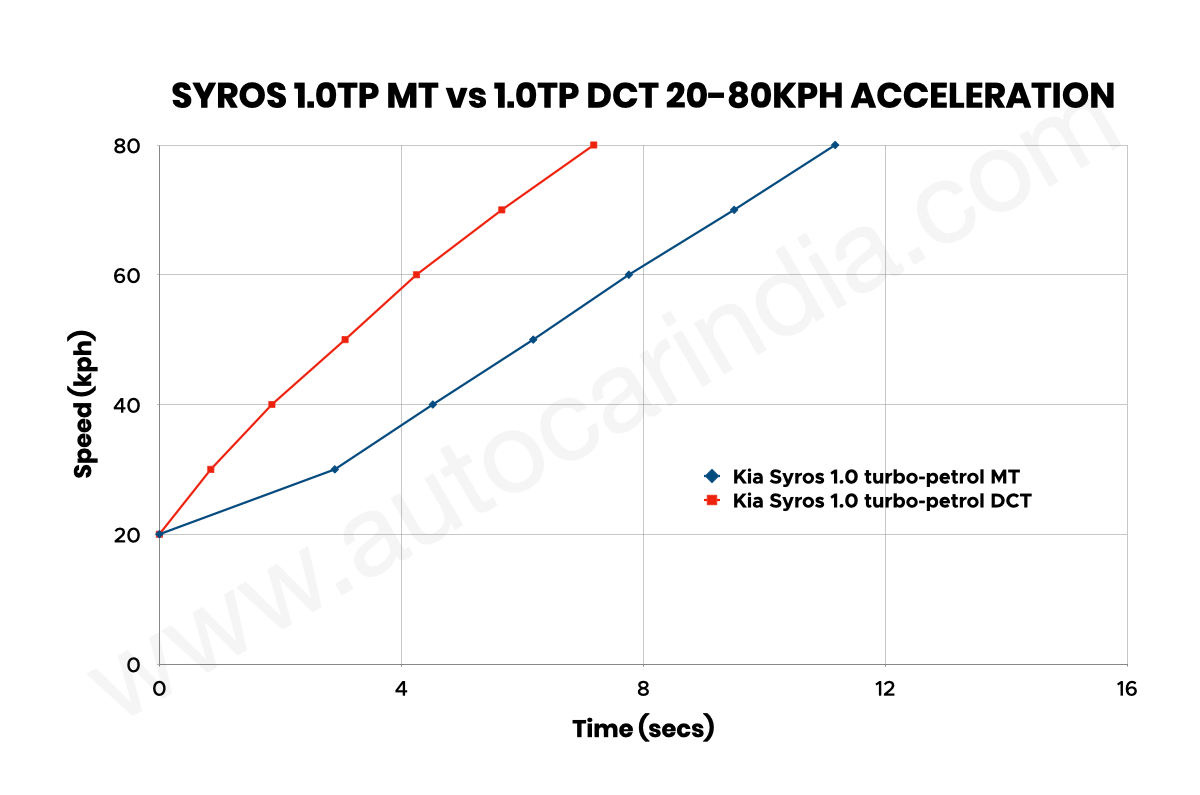
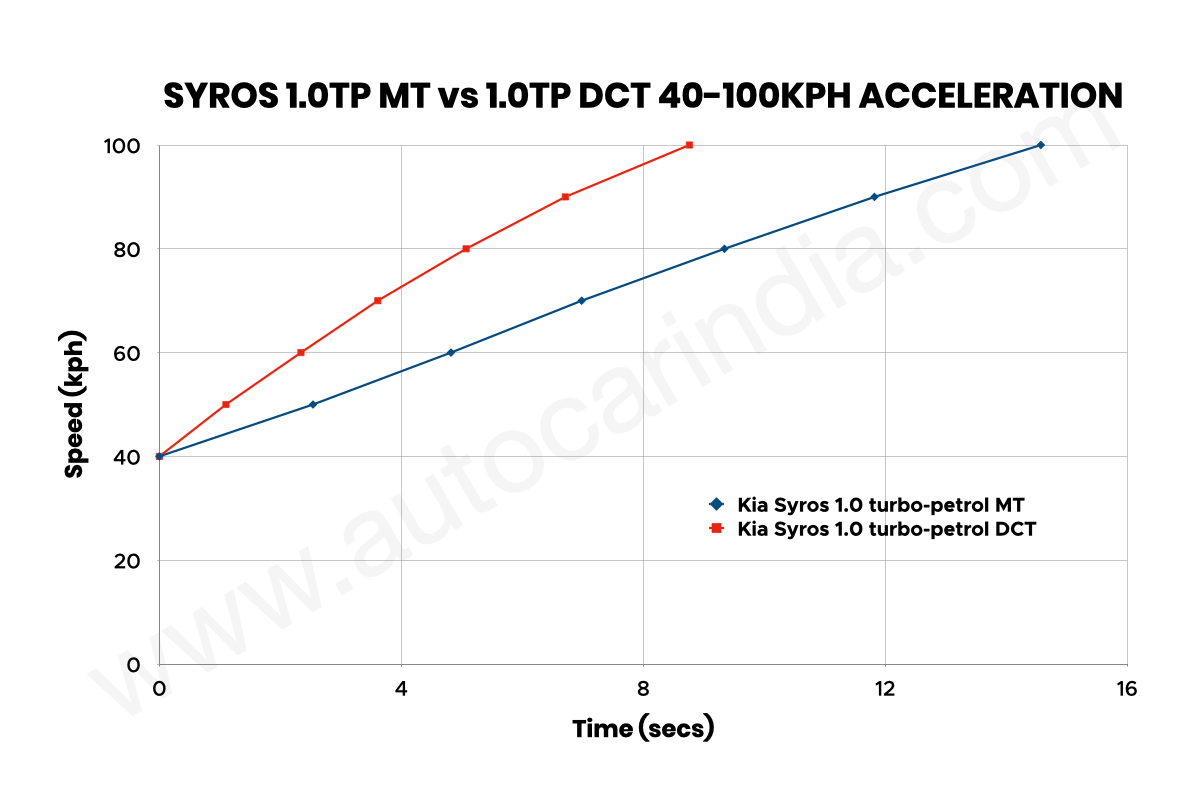
The Syros’ turbo-petrol DCT is a lot quicker than the manual in rolling tests
The in-gear acceleration of the manual transmission is also slower than that of the DCT. In third gear, the Syros turbo-petrol DCT takes 3.99 seconds less to reach 80kph and 5.81 seconds less to reach 100kph in fourth gear.
Autocar India’s testing standards
Before we conduct our performance tests, we check and maintain tyre pressures based on the manufacturer’s recommendation and ensure the car has a full tank of fuel. The car is then tested in a controlled environment with two people on board, and the data is collected via highly accurate GPS-based timing equipment.
Prices are ex-showroom, India.
from Autocar India https://ift.tt/wgXyYqc


Comments
Post a Comment